Voice-learning AI writing platform
Coldcheck
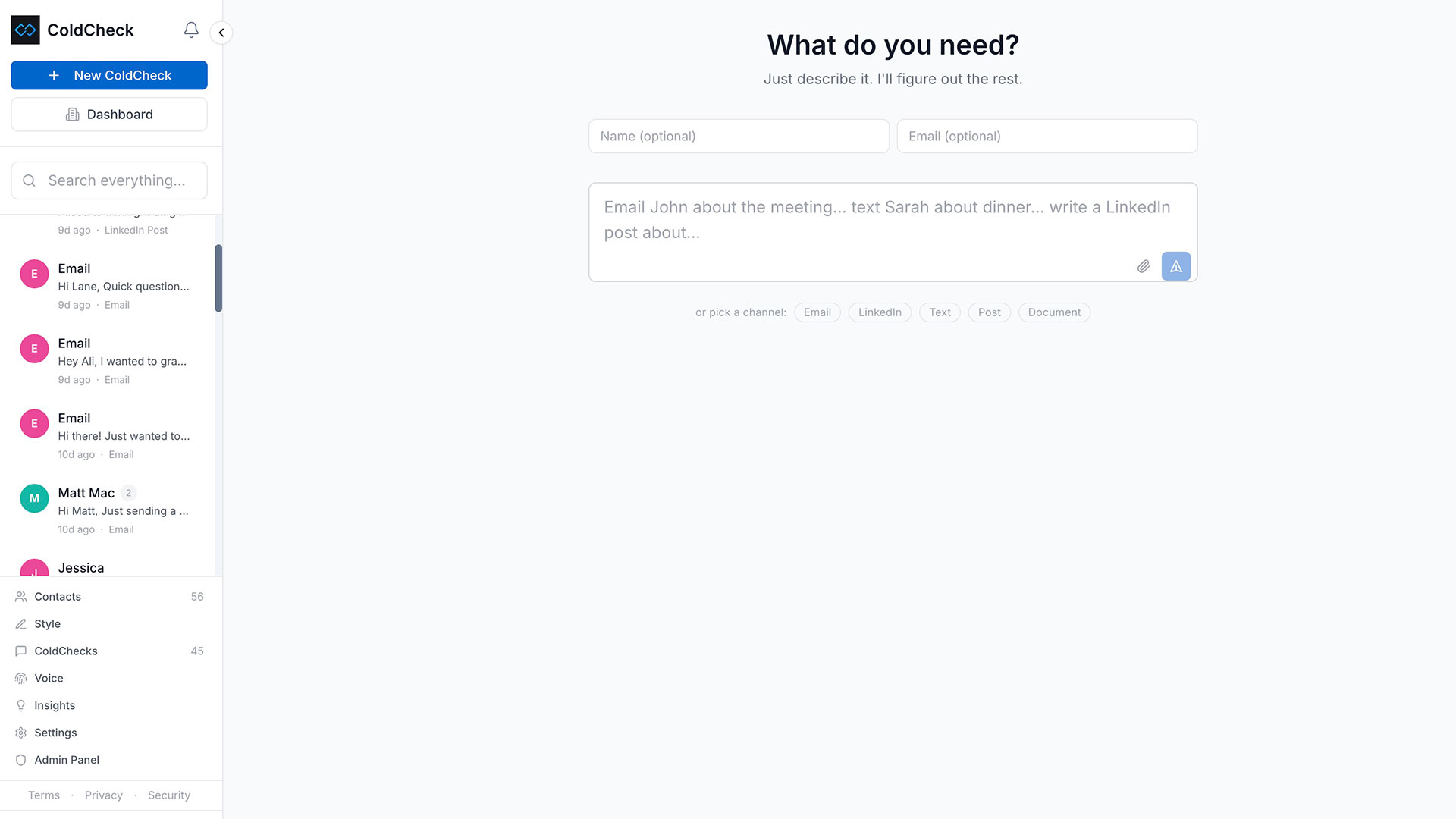
An AI writing tool that learns how each user sounds and drafts emails, LinkedIn messages, and posts in their voice. Web app plus Chrome extension with one-click insert into Gmail, Outlook, and LinkedIn. A coaching engine refines drafts based on real outcomes.
The problem
Generic AI writers sound like generic AI writers. Sales reps and founders open ChatGPT for an email, then spend more time editing the robot voice out than they would have spent writing it themselves.
The opportunity wasn't a smarter draft generator. It was one that actually sounded like the user. Fast enough to be useful in the moment, integrated where they actually write, honest about what's working and what isn't.
What I built
Built voice learning that starts from 3–5 emails the user has already sent. The system stores style patterns, not raw text, then uses them as the user's writing fingerprint on every future draft. Voice quality is monitored continuously, with an admin surface for inspecting fingerprints and prompt versions.
Drafts run through Claude Sonnet 4.5 with the user's fingerprint, recipient context the system learns over time, and channel-specific defaults for email, LinkedIn DMs, and LinkedIn posts. OpenAI GPT-4o sits behind it as a fallback. Long-context analysis lets the same engine reason across whole threads, not just the last message.
Shipped a Chrome extension (MV3) that puts the same drafting surface inside Gmail, Outlook, and LinkedIn with one-click insert into the native compose box, so users don't context-switch out of where they already work. Both the web app and extension share auth, sessions, and rate limits.
A coaching engine watches outcomes (replies, no-replies, follow-ups) and refines future drafts based on what's actually landing. Layered on top of that: per-recipient learning, deal-risk signals, follow-up suggestions, and team-level coaching for org accounts.
Underneath: NextAuth v5 for Google, Microsoft, and credentials; Prisma over Postgres with pgvector for voice embeddings; Stripe for freemium and paid tiers; Upstash Redis for rate limiting; Sentry for monitoring; encrypted token storage for OAuth credentials; Supabase realtime for live dashboard updates; SendGrid for transactional email. Background jobs handle voice fingerprint analysis, coaching cron runs, and enrichment via PeopleDataLabs.
Operations: full SOC 2-style surface (audit log, subprocessors, security, privacy, terms) plus a multi-org admin console covering usage, voice quality, prompt versions, allowlists, invites, federated learning, and team coaching. Deployed to Google Cloud Run with automated security scans (gitleaks, dependency audits) built into the release flow.
Stack
- Next.js 15
- React 19
- TypeScript
- Prisma
- PostgreSQL + pgvector
- Supabase
- NextAuth v5
- Claude Sonnet 4.5
- OpenAI GPT-4o (fallback)
- Chrome Extension (MV3)
- Stripe
- SendGrid
- Sentry
- Upstash Redis
- Google Cloud Run
Outcome
Shipped as a complete commercial product, not an MVP shell. Freemium and paid tiers, multi-org accounts, Chrome extension, full admin console, and operations docs live at launch.
Voice-learning is the wedge: drafts read as the user, not as AI. The coaching layer means the system gets sharper the more it's used.
Live at coldcheck.ai.
Working on something similar?
If this looks like the kind of work you need done, the easiest first step is a short call. I’ll tell you honestly whether I’m a fit and what it would cost.